Accounting Basics
What Is Double-Entry Accounting? Debits, Credits and Examples
Accounting basics in plain English: how double-entry accounting works, the accounting equation, debit and credit rules, and five worked journal entry examples.
By PilotLedger Team · · 8 min read
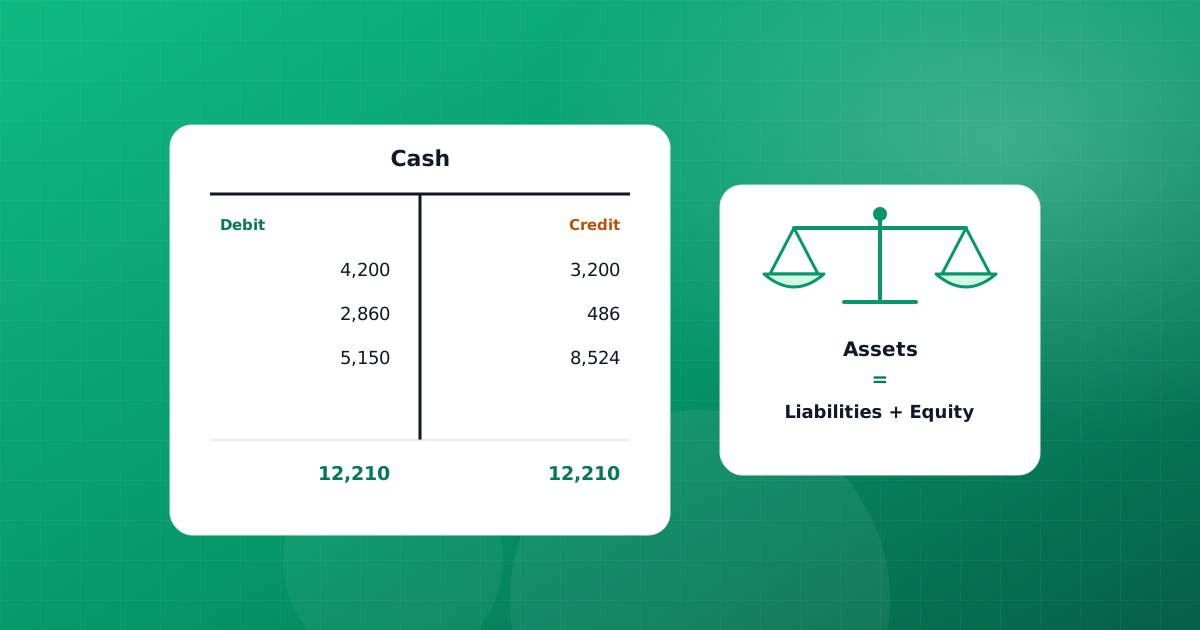
Double-entry accounting is a bookkeeping method in which every transaction is recorded in at least two accounts: one account is debited and another is credited, for the same total amount. Because each entry is balanced, total debits always equal total credits, and the accounting equation (Assets = Liabilities + Equity) always holds. For example, when you buy a $1,200 laptop with cash, you debit Equipment $1,200 and credit Cash $1,200. Nearly every business accounting system, from spreadsheets kept by accountants to modern software, is built on this method.
Double-entry accounting has been the standard for centuries because it is self-checking. If the debits and credits do not match, you know something is wrong before it reaches your reports. It also shows both sides of every transaction: not just that cash went down, but what you got in return.
The accounting equation
Everything in double-entry accounting rests on one equation:
Assets are what the business owns or is owed. Liabilities are what it owes. Equity is the owners' stake, what would remain if all liabilities were paid from the assets.
Profit feeds into equity. Revenue increases equity and expenses reduce it, so the expanded version is:
Every transaction changes at least two parts of this equation in a way that keeps it in balance. Borrow $10,000 and both assets (cash) and liabilities (loan) rise by $10,000. Pay a $300 bill and both assets (cash) and liabilities (accounts payable) fall by $300. The equation never breaks.
Debits and credits explained
In everyday language, "credit" sounds like a good thing and "debit" sounds like money leaving. In accounting, they simply mean left and right. A debit is an entry on the left side of an account; a credit is an entry on the right. Whether a debit increases or decreases an account depends on the account type.
| Account type | A debit... | A credit... | Normal balance |
|---|---|---|---|
| Assets | Increases | Decreases | Debit |
| Expenses | Increases | Decreases | Debit |
| Owner's draws | Increases | Decreases | Debit |
| Liabilities | Decreases | Increases | Credit |
| Equity (capital) | Decreases | Increases | Credit |
| Revenue | Decreases | Increases | Credit |
An easy way to remember it: accounts on the left side of the equation (assets) and things that reduce equity (expenses and draws) increase with debits. Accounts on the right side (liabilities and equity) and things that increase equity (revenue) increase with credits.
Some people use the memory aid DEALER: Dividends (or draws), Expenses and Assets increase with debits; Liabilities, Equity and Revenue increase with credits.
Double-entry accounting examples
Here are six common transactions for a small design studio, written as journal entries. In each one, total debits equal total credits.
1. The owner invests cash to start the business
The owner deposits $5,000 of personal savings into the business bank account.
| Account | Debit | Credit |
|---|---|---|
| Cash (business checking) | $5,000 | |
| Owner's capital | $5,000 |
Assets go up $5,000 and equity goes up $5,000. The equation stays balanced.
2. Buying equipment with cash
The studio buys a $1,200 laptop and pays from the bank account.
| Account | Debit | Credit |
|---|---|---|
| Equipment | $1,200 | |
| Cash | $1,200 |
One asset increases and another decreases by the same amount. Total assets do not change, only their mix. The laptop will later be expensed gradually through depreciation.
3. Invoicing a customer
The studio finishes a $2,500 branding project and sends an invoice on Net 30 terms.
| Account | Debit | Credit |
|---|---|---|
| Accounts receivable | $2,500 | |
| Service revenue | $2,500 |
Under accrual accounting, revenue is recorded when earned, not when paid. The customer now owes $2,500, which appears in accounts receivable.
4. Receiving payment for the invoice
Three weeks later, the customer pays the $2,500 in full.
| Account | Debit | Credit |
|---|---|---|
| Cash | $2,500 | |
| Accounts receivable | $2,500 |
No new revenue is recorded, because it was already counted when the invoice was issued. The asset simply changes form, from receivable to cash.
5. Recording a bill and an expense
The studio receives a $400 bill for software subscriptions, due in 15 days.
| Account | Debit | Credit |
|---|---|---|
| Software expense | $400 | |
| Accounts payable | $400 |
When the bill is paid, a second entry debits Accounts payable $400 and credits Cash $400. The expense is recognized once, when incurred, and the payment clears the liability.
Checking the result
After the first five entries, the studio's equation reads: Assets (cash of $6,300 plus equipment of $1,200, with receivables back to zero, for $7,500 before paying the bill) equal Liabilities ($400 accounts payable) plus Equity ($5,000 capital + $2,500 revenue − $400 expense = $7,100). That is $7,500 = $400 + $7,100. Balanced.
6. Taking an owner's draw
At month end, the owner transfers $1,000 from the business account for personal use.
| Account | Debit | Credit |
|---|---|---|
| Owner's draw | $1,000 | |
| Cash | $1,000 |
A draw is not an expense, so it does not reduce profit. It reduces equity directly. This is one of the most common mistakes in self-kept books: recording personal withdrawals as expenses understates profit and misstates taxes.
T-accounts: a visual way to see debits and credits
Accountants often sketch accounts as a large letter T, with debits on the left and credits on the right. Here is the Cash account after the six transactions above:
| Cash: debits (left) | Cash: credits (right) |
|---|---|
| $5,000 owner investment | $1,200 laptop |
| $2,500 customer payment | $400 software bill paid |
| $1,000 owner's draw | |
| Total $7,500 | Total $2,600 |
The balance is $7,500 − $2,600 = $4,900, a debit balance, which is normal for an asset. Doing a quick T-account on paper is the fastest way to check an entry you are unsure about: if cash went up, it must be a debit to cash, and something else must be credited.
Common debit and credit mistakes
- Treating "credit" as good and "debit" as bad. They are just sides. Expenses are debits, and that is correct.
- Reading your bank statement's terms as yours. Your bank "credits" your account when you deposit money, because to the bank your deposit is a liability it owes you. In your own books, the same deposit is a debit to cash.
- Recording loan repayments as expenses. Only the interest is an expense. The principal reduces the loan liability.
- Recording sales tax as revenue. Tax collected is a liability until you pay it to the state.
- Booking equipment as an expense. Long-lived equipment is an asset, expensed gradually through depreciation.
- One-sided corrections. Fix an error with a balanced correcting entry, or by reversing the original and re-entering it, rather than editing a single line.
Single-entry vs double-entry accounting
Single-entry bookkeeping records each transaction once, usually as a line in a cash book or spreadsheet with income in one column and expenses in another. It is like a checkbook register.
| Single-entry | Double-entry | |
|---|---|---|
| Entries per transaction | One | Two or more, balanced |
| Tracks | Cash in and out | Assets, liabilities, equity, revenue and expenses |
| Produces a balance sheet | No | Yes |
| Built-in error check | No | Yes, debits must equal credits |
| Handles receivables, payables, inventory | Poorly | Fully |
| Best for | Hobby-scale or very simple cash businesses | Any business that invoices, has bills, loans or plans to grow |
Single-entry is quicker to learn, but it cannot tell you what you owe, what you are owed or what the business is worth. Double-entry can, and modern software does the debits and credits for you, so the extra effort is minimal.
Why double-entry accounting is worth it
Double-entry takes a little more thought up front, but it pays back in four practical ways:
- Built-in error checking. If a transaction is entered with unequal sides, the books will not balance, so the mistake surfaces immediately instead of months later.
- A complete picture. You see not only profit, but also cash, what customers owe, what you owe, inventory, loans and equity. That is what lenders and investors ask for.
- Accurate profit. Combined with accrual accounting, double-entry matches income with the costs of earning it, so each month's profit reflects that month's work.
- An audit trail. Every amount on a report traces back to a dated, balanced journal entry, which makes reviews by an accountant or tax authority far easier.
It also scales. The same method that records a freelancer's first invoice works for a business with inventory, multiple currencies and a team of users. Switching from single-entry later means rebuilding your records, so starting with double-entry from day one saves work as you grow.
From journal to reports
Double-entry accounting follows a simple flow:
- Transactions are recorded as journal entries, either by hand or automatically when you create an invoice, bill or expense in software.
- Entries post to the general ledger, which holds the running balance of every account in your chart of accounts.
- A trial balance lists every account balance and confirms total debits equal total credits.
- Financial statements are prepared from those balances: the profit and loss statement from revenue and expense accounts, and the balance sheet from asset, liability and equity accounts.
Note that a balanced trial balance does not prove the books are perfect. An entry posted to the wrong account, or a transaction left out entirely, still balances. That is why bank reconciliation and regular review remain important.
Double-entry accounting in software
You do not have to write journal entries by hand for everyday work. In double-entry accounting software like PilotLedger, creating an invoice automatically debits accounts receivable and credits revenue; recording a payment debits the bank account and credits receivables; and with inventory tracking on, selling a tracked item also posts cost of goods sold. You can still enter manual journal entries for adjustments such as depreciation, and the software will not save one that does not balance. Reports including the trial balance and general ledger come straight from the ledger, so they are always in sync. See our financial reports page for the full list.
Understanding debits and credits still pays off. It helps you read reports, spot entries that look wrong, and talk confidently with your accountant. Learn the equation, learn the rules table above, and the rest follows.